
For decades, enterprise technology optimized around a single objective: winning the close. But in the age of AI, the transaction is no longer the finish line.
AI products break traditional commercial logic. Revenue is consumption-led, and value is co-produced. Because customers must alter their operational data and workflows to unlock the system’s potential, the traditional sales playbook no longer applies.
This dynamic creates a blind spot for CROs. Two accounts can close on identical contracts and look indistinguishable in the pipeline. Yet months later, one accelerates into continuous value creation while the other stalls. Their trajectories diverge long before renewal, obscured by a commercial apparatus designed exclusively for bookings.
SaaS was built to turn qualified demand into contracts. Advanced AI demands that we turn use cases into sustained consumption. One is a predictable funnel; the other is a continuous cycle.
To be sure, this transformation is nuanced. Standard copilots and task-automation features still sell through traditional SaaS channels. However, engineered AI systems—from autonomous agents to deeply integrated workflows—require a total commercial reset. Here, we examine the logic behind that shift and the organizational questions leaders must face.
Six Critical Shifts Transforming Enterprise AI Sales
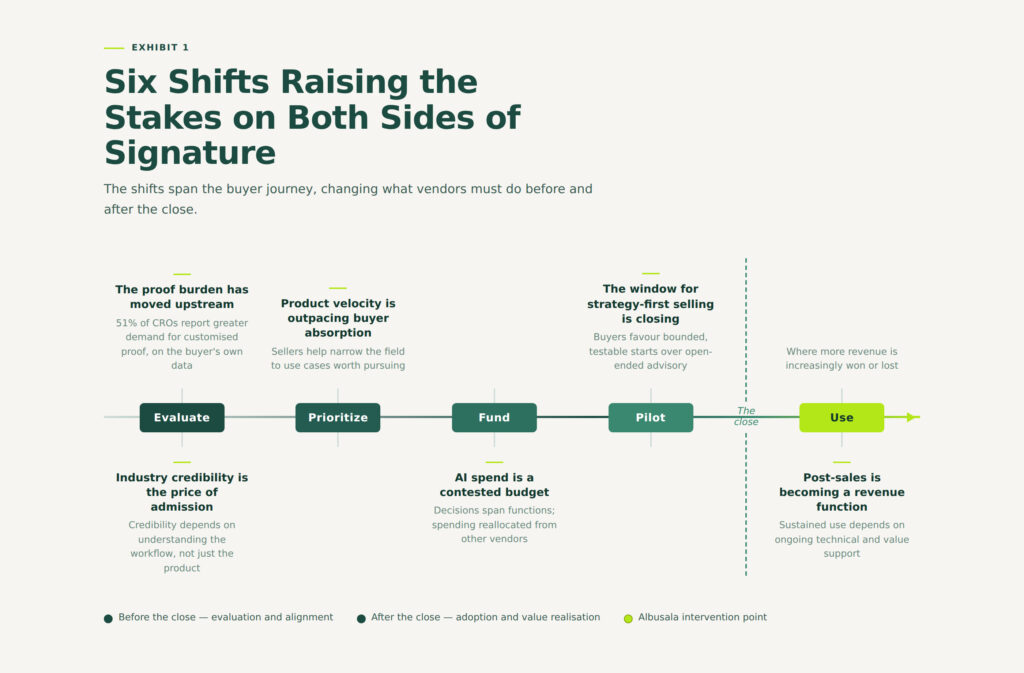
Buyers are inundated with AI options; what they lack is certainty. A recent BCG CRO survey shows that 51% of CROs report a surge in demand for customized proof of value tailored directly to the customer’s data and workflows—pulling the burden of proof much earlier into the sales cycle.
This new reality is defined by several critical market shifts:
- Precision Discovery: Because AI evolves faster than buyers can evaluate it, discovery must narrow the field. Sellers must anchor on a high-value use case and establish clear criteria for success, where deep industry credibility is the ultimate price of admission.
- Budget Competition: Securing the use case means winning priority across cross-functional budgets. With customers often reallocating spend from legacy vendors to fund AI, traditional players and AI-native startups are fighting for the same finite pool of capital.
- Fatigue with Open-Ended Strategy: The appetite for endless advisory and maturity exercises is fading. Buyers favor bounded, testable execution—using time-bound bootcamps, discovery sprints, and structured pilots to drive decisions.
- The Post-Signature Imperative: The commercial journey doesn’t end at the close. Because true system performance only emerges when AI meets live enterprise data, vendors must embed technical engagement deep into the post-sale lifecycle, treating post-sales as an explicit revenue driver.
Ultimately, these dynamics rewrite the rules of go-to-market execution. AI vendors must guide customers to the right bets, generate ongoing evidence to maintain momentum, and stay locked in until code translates into sustained consumption. (See Exhibit 1.)
From Funnel to Flywheel
A single contract can contain multiple, conflicting commercial realities: one use case moving into production, another struggling for adoption, and a third ready to scale.
Traditional sales funnels work when deployment is simple and revenue is front-loaded at the signature. But as AI deployments grow engineering-intensive—requiring deep changes to customer data, workflows, and behavior—the linear funnel breaks down:
- The Proof Gap: Standard demos prove the technology works, but fail to prove it works in the customer’s environment.
- The Production Wall: Moving to production exposes data quality, integration, and governance constraints that pilots easily sidestep.
- The Adoption Stalled-State: Without active workflow redesign, usage drops off.
By renewal time, success has already been decided by months of operational reality. For advanced AI, the signature is no longer where the sale is won—it is merely the starting line.
The Flywheel Advantage
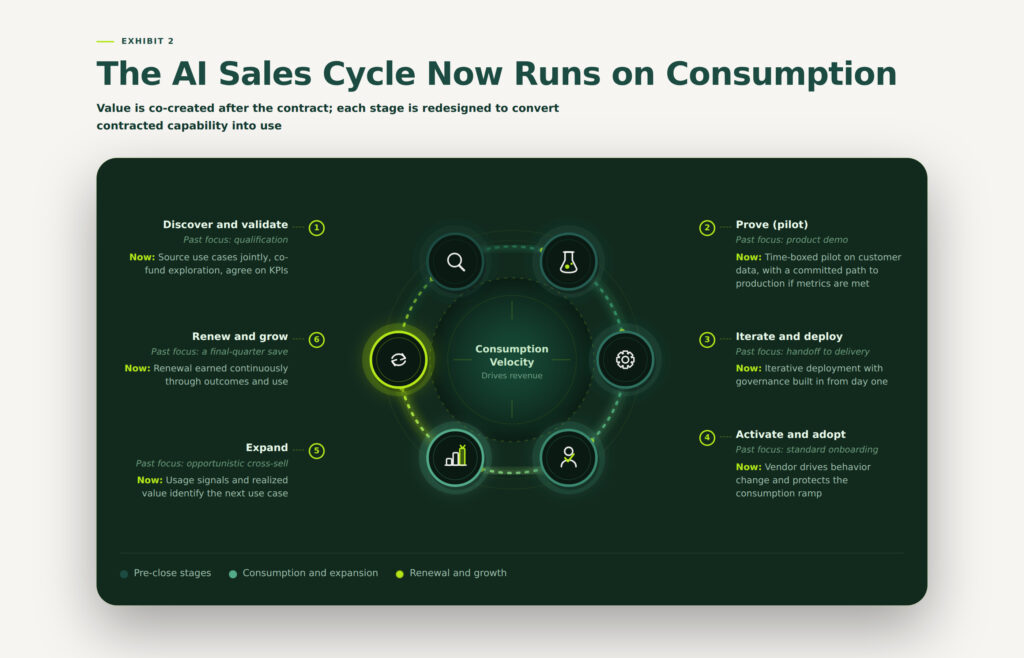
Complex AI demands a flywheel model where continuous consumption drives continuous growth:
- Upstream: Proof-of-value exercises build foundational trust.
- Midstream: Iterative deployments adapt to real-world technical and organizational constraints.
- Downstream: Ongoing technical engagement transforms deployed code into active, sustained consumption.
Usage signals replace pipeline stages, guiding teams on where to expand, intervene, or initiate the next discovery cycle across multiple simultaneous use cases within an account. (See Exhibit 2.)
These dynamics reshape the commercial model in two fundamental ways:
- The Rebalancing of the Lifecycle: Pre-sales and post-sales now carry the heaviest commercial weight. Driven by demands for early proof, technical validation flows directly into deployment. Expansion loops back into discovery, and renewals are earned through continuous adoption rather than closed at the signature—making the transaction just one milestone in a broader journey.
- Workload-Driven Economics: Traditional contract values are no longer reliable barometers of health. Account economics must be forecast by workload, tracking use-case pipelines, consumption velocity, and expansion potential.
Ultimately, vendors that stop at technical delivery choke their own potential. To ensure adoption of complex AI, suppliers are stepping into operational domains traditionally owned by customers or systems integrators—managing workflow integration, defining new decision rights, and engineering organizational change.
Architecting the Post-Close Commercial Model
There is no single operating model for every AI product. Companies must differentiate their commercial motion based on product and deployment complexity: standardized task-automation tools require minimal post-sale intervention, while configurable agents and workflow-transforming systems demand deep discovery, iterative deployment, and sustained adoption support. Applying a one-size-fits-all approach either makes simple products too expensive to sell or leaves complex solutions without the support they need to reach sustained consumption.
This reality reshapes the operating model across four critical dimensions:
The AE as Value Architect: Account executives shift from transactional selling to orchestrating cross-functional pods and sequencing complex use cases. As AI automates routine outreach, the AE role increasingly centers on strategic judgment and long-term account progression.
The Dissolving Technical Divide: The boundary between pre-sales and post-sales engineering is breaking down. Because discovery, pilot execution, and deployment rely on continuous context regarding the customer’s data and workflows, rigid handoffs risk destroying vital insights. Emerging roles—such as forward-deployed engineers and AI outcome managers—bridge this gap to ensure operational continuity.
Post-Sales as a Commercial Investment: Customer success is bifurcating, pairing generalist coverage with deep technical and domain experts where adoption requires hands-on intervention. Professional services is becoming a strategic battleground, requiring vendors to carefully calibrate how they subsidize early discovery and monetize scaled accelerators or center-of-excellence support.
Consumption-Driven Forecasting and Compensation: Extended commercial terms (such as five-year contracts) can mask severe risk beneath the surface. If an account stalls at its initial use case, underconsumption becomes a silent threat. Leading organizations are tying forecasting directly to consumption telemetry and restructuring compensation so that both AEs and technical specialists are rewarded for long-term expansion and sustained usage.
Organizations that have begun making these adjustments are already discovering where traditional operating models strain—and where the future of AI commercial design is heading.

The Hard Questions Come Next
The market is still evolving, but vendors do not need to wait for it to settle. CROs can test their commercial model with a single, clarifying thought experiment: Strip bookings out of the picture. If revenue reflected only what customers actually consumed, where would it grow, where would it vanish, and why?
The answer immediately exposes where contracted value converts into consumption, where it stalls, and where the current commercial engine is working against the product. From there, leadership teams must address a critical set of strategic questions:
Where does the flywheel apply? Which products, use cases, and customer segments require intensive discovery, iterative deployment, and adoption support—and which can still be sold through a conventional motion? Should this distinction hinge on technical complexity, workflow risk, or value at stake?
What constitutes proof, and when? What specific evidence moves a customer from interest to pilot, pilot to production, and production to scale? Who owns the burden of creation, and what should the vendor fund, charge for, or standardize?
Who owns progress through the cycle? Which roles require continuity from first pitch to scaled consumption? Where can ownership transition safely without losing vital context, and who is ultimately accountable when contracted capacity sits idle?
What telemetry matters most? Which signals reveal that a deployment is accelerating, stalling, or primed for expansion? How should those indicators dynamically adjust forecasting, resource allocation, and the timing of the next use case?
How do incentives and terms align? What should account executives, technical specialists, and customer success teams be rewarded for, and over what horizon? How must pricing, crediting, and multi-year commitments adapt when revenue depends entirely on sustained usage?
What is the economic boundary? Where does high-touch technical and domain support generate enough incremental consumption to justify its cost? What must be productized or pooled, what requires dedicated coverage, and how does this allocation shift across strategic accounts versus the broader enterprise base?